
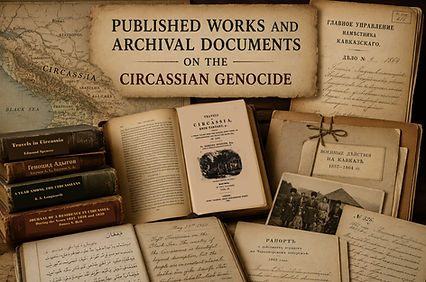
Published Works and Archival Documents on the Circassian Genocide
This collection aims to present historical, academic, and eyewitness accounts related to the Circassian Genocide and the Russian invasion of Circassia. It is intended to serve as a comprehensive resource for researchers, academics, students, policymakers, and all those seeking a deeper understanding of the Circassian Genocide and its enduring consequences.
The Russian imperial expansion into the Caucasus during the 18th and 19th centuries represents not only a prolonged military conflict, but also a profound historical rupture involving large-scale demographic, cultural, and social transformation.
Between 1763 and 1864, the Russian Empire carried out a systematic campaign of destruction against the Circassian nation during its invasion and occupation of Circassia in the Western Caucasus. Throughout this 101 year war, hundreds of thous ands of Circassians were killed; villages, towns, cultural centers, forests, and agricultural lands were burned and destroyed; families were torn apart; and deliberate famine and disease were used as tools of annihilation. When the population was weakened and exhausted, and the Circassians had completely lost the strength to resist this systematic oppression, the Empire initiated a planned mass expulsion in 1860s. As a result, more than 90% of the Circassian population was either killed or forced into exile. Hundreds of thousands perished during deportation due to starvation, epidemics, and exposure.
These acts of violence committed by Russia against the Circassian and other Caucasian peoples are documented in the works of contemporary witnesses and later researchers. Although the term “genocide” was first introduced by Raphael Lemkin in 1944, it is used to describe the atrocities that occurred during the Russian invasion of Circassia nearly a century earlier. Even if the term itself does not appear in contemporary accounts, numerous reports describe systematic killing and destruction carried out and planned by the Russian army in order to secure the invasion.
Some of these works were produced under the supervision or influence of Russian military officials, and therefore clearly served propaganda purposes aimed at legitimizing Russian actions. Ditson (American) dedicates his work to Prince Vorontsov, whom he praises extensively. Klaproth (German) and Dubois de Montpéreux (Swiss) completed their travels under Russian patronage and are believed to have relied heavily on information provided by Russian authorities. Similarly, in the works of Russian authors such as Shcherbina, Berje, Pushkin, and Fadeev, numerous arguments are presented that defend Russia’s invasion of Circassia and the violent practices carried out during this process. As such, readers may encounter expressions that challenge moral and ethical criterias.
Nevertheless, these works remain valuable for understanding the conditions of the period, the ideological justifications used by the Russian Empire, and the structure of its propaganda discourse. Within this literature, Circassians are frequently described as “savage bandits,” as being outside civilization, and as engaging in slave trade. The destruction of villages, including women and children without distinction, is often framed as punishment, discipline, or a civilizing mission.
What supreme justification can legitimize violence that drives an entire nation to the brink of extinction?
Moreover, some narratives surrounding slave trade often portray Circassian society as if all Circassians were commodities to be bought and sold. In reality, slave trade was practiced only by a limited segment of Circassian society and was widely criticized by the broader population. The majority of Circassians were free peasants, and slavery existed in restricted forms. It should also be remembered that various forms of slavery existed in many societies of the period, including Russia itself.
At the beginning of the Russian invasion, Circassia did not possess a centralized state or a regular army. However, it did have a strong social system that regulated communal life. Roles and responsibilities within society were organized in a structured manner. In addition, Circassian society developed various forms of production and trade, including metalwork, silk production, and leather craftsmanship. The Circassians also created a distinctive cultural and artistic aesthetic. Although not comparable to the major imperial states in political or military terms, Circassian society was nonetheless well-developed in relation to other small societies of the period.
Even Ditson, in the final paragraph of his introduction, critically evaluates the Western understanding of civilization and argues that Circassian society embodies values that could serve as an example to Western civilization, particularly in terms of respect for human being. The most significant blow to Circassian development from the 18th century onward was the destructive Russian invasion. Therefore, to argue that Circassians are “uncivilized” and that their country should therefore be invaded is to serve imperialism perfectly.
Humanity must critically reassess narratives originating from Russian sources. Was Russia’s objective in the 18th century truly to bring civilization, or was it primarily driven by military, political, and economic interests? This question must be considered alongside historical examples such as the expansion into Poland and the Baltic regions, as well as the dispatch of Russian officials to Western Circassia in 1781 to investigate mineral resources. Furthermore, the economic, social, and political conditions of these regions today are essential for understanding the long-term consequences of occupation.
Today, in a region rich in natural resources yet condemned to poverty, deprived of political freedom, subjected to long prison sentences for minor acts of dissent, and forced into silence as its culture, history, and values are eroded through imposed narratives, what kind of “civilization” claim can Russia possibly make?
Moreover, the consequences of the Circassian Genocide cannot be regarded as confined to the nineteenth century alone. More than 160 years after the mass expulsions and destruction of Circassian society in its homeland, the Russian state has undertaken no comprehensive effort to address the historical injustices suffered by the Circassian people. There has been no official recognition of the genocide, no meaningful process of restitution, no state-sponsored mechanism for preserving the demographic, cultural, and linguistic continuity that was shattered by the expulsions, and no serious attempt to facilitate the return of the Circassian diaspora to its ancestral homeland. On the contrary, Circassian historical memory and political demands continue to face various forms of marginalization, while the long-term consequences of forced displacement remain largely unaddressed. In this sense, the genocide persists not only in historical memory but also in the unresolved political, cultural, and demographic realities that continue to shape Circassian existence today.
The materials presented here are intended to serve as a living archive for understanding the Circassian Genocide and will continue to be expanded over time with newly discovered academic works, testimonies, and archival sources.
International Circassian Political Committee
06.06.26